This is the Intellectual property, game design & concept art for Everlost. This is Copyright © 2025 Khor Atheliem. All rights reserved.

You will notice that the door is at the top of the mountain. It’s a homage to J. R. R. Tolkien.
Introduction
There are actually two different phases of development. In the initial years, the system was designed to be superimposed on top of already-existing games in order to make them playable in the manner that I desired. It wasn’t until 2017 that the notion of using the system as a Band-Aid for other games was abandoned. I created the system specifically for my own games and called the system 黑山 “Black Mountain Core.” I also decided to drop the idea of having to pick between science fiction and fantasy, drawing inspiration from cartoons during the1980s. Some of these shows successfully combined the two genres.
How this came to be.
I’ve been scribbling down ideas since 2011, when I returned to board gaming, even before I left the UK to live in China. It was a confluence of factors. First, I was having nostalgic memories of the first time I acquired a copy of Hero Quest in the 1980s. Secondly, at that time, I had moved away from mainstream media and toward internet content. I was watching shows like Dice Tower by Tom Vasel for reviews on upcoming board game releases. The third, a lot of games I bought, featured amazing boards, tokens, box art, and sculptures, but I utterly detested their rules and their lazy or boring game mechanics.
History of development
Stage One: 2011 System Overlay 0.1
The 1980’s Hero Quest and the mid 2000’s Arcadia Quest are two of the games that influenced my 1st choice. In the beginning, I was considering the concept of personalized dice. This being Custom D6 dice, but it appeared to be exceedingly costly when I considered the implications of actually making those dice. I discovered this by examining Arcadia Quest and the small quantity of custom dice that were included in each box set, unless you paid extra during the Kickstarter.
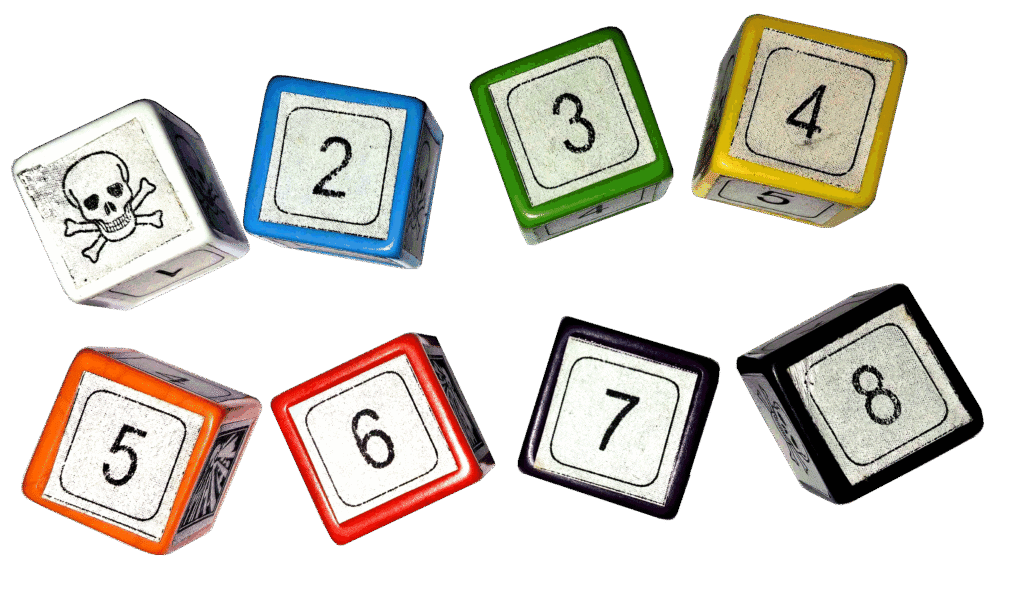
My original custom Dice plan:
The concept was to use dice of various colours to symbolize various power levels. White is the lowest power level, followed by blue, green, yellow, orange, red, purple, and black. The die numerical outcomes would progressively rise with each power level. Each die had a face to represent a crucial success and another face to represent a fumble. Therefore, you might roll several critical successes or multiple fumbles regardless of power level.
The concept was that if you made several mistakes, your weapon may jam or, in worst cases, explode, killing you. Your attack damage could be doubled or tripled if you had several critical successes. In terms of arithmetic, this would have been acceptable for a computer game. However, this was merely becoming more of a math lesson, doing equations and viewing charts reminiscent of early tabletop games. This was not fun.

Stage Two: 2012 System Overlay 0.2
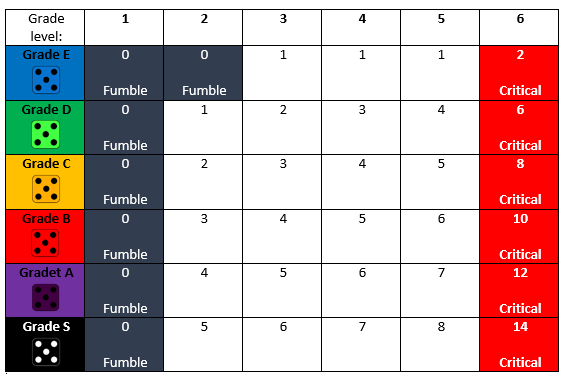
I then considered switching to standard d6, as this is a cheaper solution than custom dice. This was comparable to the feel of war hammer, due to the thrill of tossing handfuls of dice. The dice colour, power level, and crit, fumble mechanism, I retained from the previous version. A one result on a dice roll would be a failure, and six would be a critical. I no longer needed bespoke dice. However, when I tested it, it was just as annoying as playing a game of Warhammer Apocalypse. Counting up the sheer number of dice is time-consuming, and each power level felt too uniform. I wasn’t getting the epic feeling of watching Goku in Dragon Ball as he gains power levels. Super Saiyan, Super Saiyan God, Super Saiyan Blue.
Stage Three: 2015 System Overlay 0.3
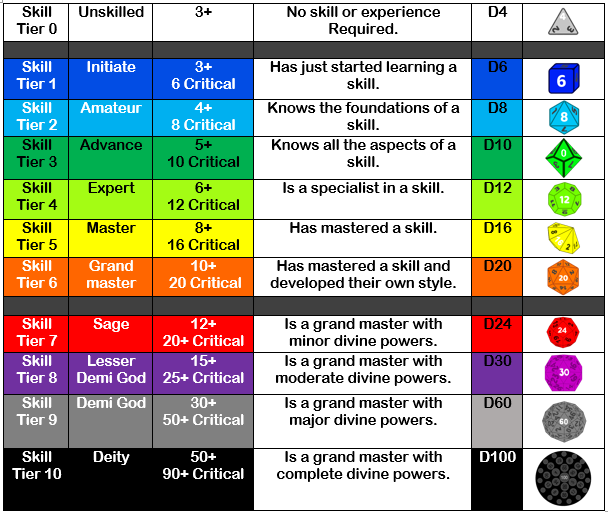
After that, I made the decision to switch to D&D dice. I wanted to imitate how power level increases in TV series like Dragon Ball Z. Working on a skill or stat will lead to more potent ability output. I picked the following specialist dice. D4, D6, D8, D10, D12, D16, D20, D24, D30, D60 and a D100. You can see that there were going to be some major mathematical problems in roles with the range of dice I picked, even if I was able to accomplish the thrill and awe of gaining a greater power level.
Stage Four: 2017 Black Mountain Core 0.0
Because there were too many specialized dice in the previous edition, the max result of each variant of dice prevented a smooth progressive result outcome. So I only selected two specialty dice. I selected the D4 & D8 from the last stage since, in Chinese tradition, a D8 is a lucky number and a 4 is unlucky. This made it possible to enhance power by a factor of four at every level. The result Power level one was 1 D4, power level two was 1 D8, and power level three was 1 D8 + 1D4. However, this meant that by the time you reached Max power level, level 8. Your maximum dice result was 32, which didn’t make you feel particularly powerful. This scale needed to be doubled or tripled to work.
Stage Five: 2019 Black Mountain Core 0.1
This is where I drastically altered the power levels; everyone starts at power tier one, and there is only one power level. Each additional power tier was divided into three power levels. Low, mid, and high. All of them were given names. Once you’ve reached the top, you’ll advance to the next power tier. This allowed the player to gain extra dice in the same way as the last version. However, I suddenly felt that I had too many power levels (7×3 +1 = 22 levels). Reducing the colours from 8 to 6 resulted in a total of 16 power levels. The highest result in this system was 64.
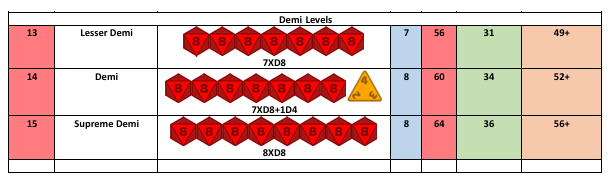
Stage Six: 2021 Black Mountain Core 0.2
As a high-tier character, I threw too many D8 dice, which was similar to the second stage design flaw of tossing too many D6 dice. It didn’t feel heroic or strong enough at the higher tiers. so each 2 D8 dice would be replaced with a D16. This also increased maximum power from 64 to 88, a Chinese lucky number.
Stage Seven: 2025 Black Mountain Core 0.4
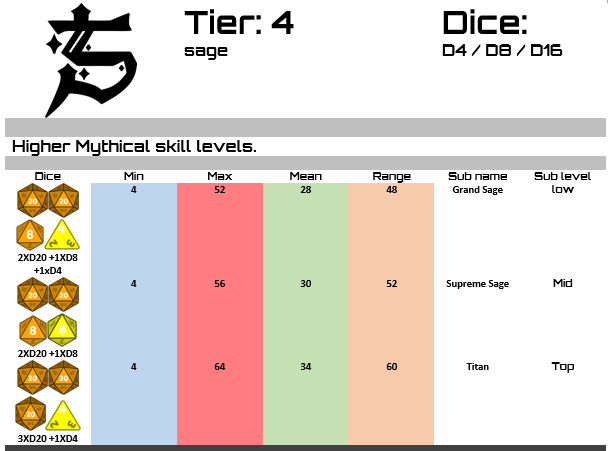
D4, D8, and D16 look aesthetically pleasing. However, I changed D16 to D20 for two reasons. First, a D16 is a lot like a spinning top; To get the side with the 16 face on it, someone can easily cheat. If the die is not rolled fairly. Second, as it’s a highly specialized die, this would eventually raise the product’s manufacturing price needlessly. Procuring D20s is a lot easier.